Skye - Vector Similarity Search Platform
Skye is BharatMLStack's vector similarity search platform that enables fast semantic retrieval by representing data as vectors and querying nearest matches in high-dimensional space. It is composed of three runnable components: skye-admin, skye-consumers, and skye-serving.
System Overview
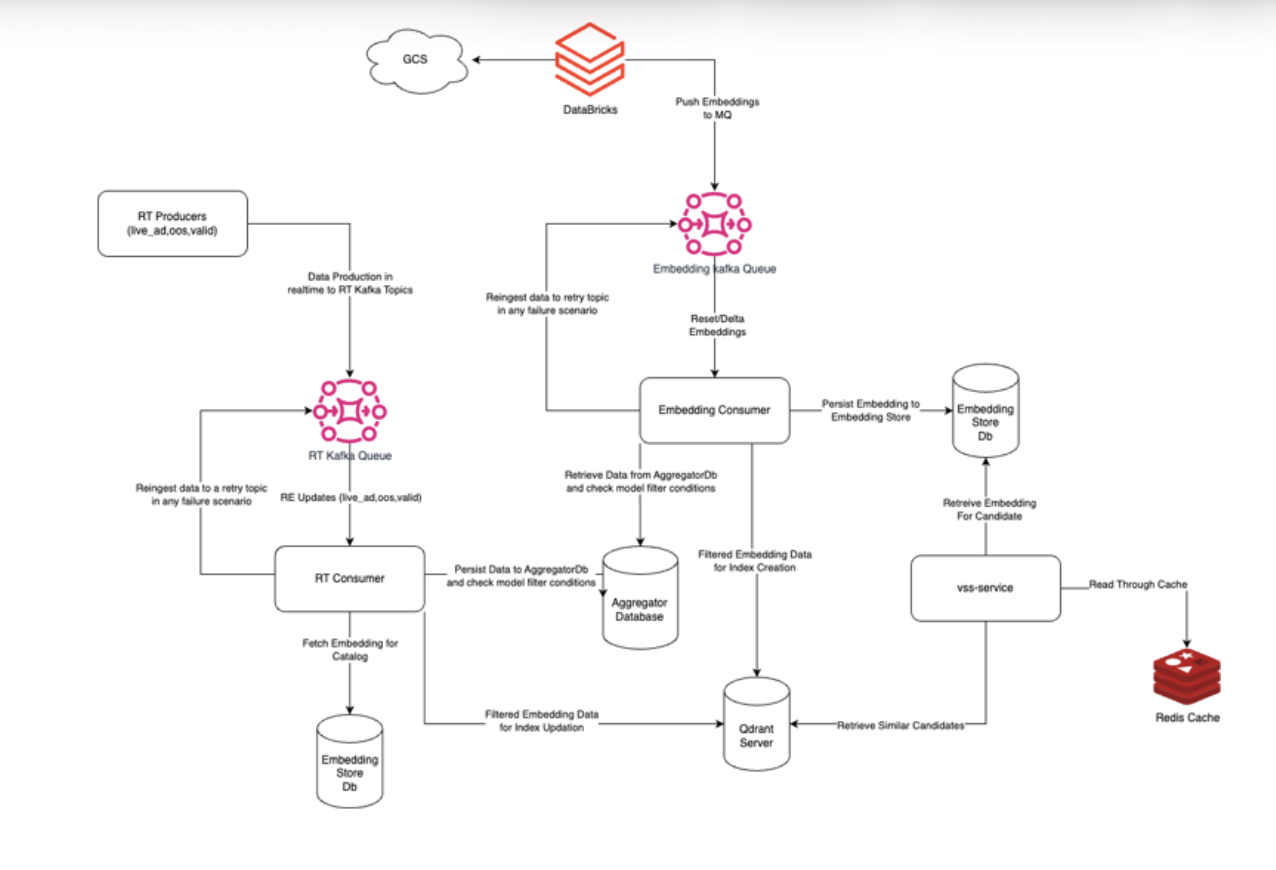
Skye provides a critical platform for managing data aggregation, model onboarding, and embedding support at production scale. The architecture is designed around three core pillars:
- Pluggable Vector Databases: Support for multiple vector database backends (Qdrant and extensible to others) via a generic abstraction layer.
- Tenant-Level Index Isolation with Shared Embeddings: Models are stored once but can serve multiple tenants (variants), reducing data redundancy.
- Event-Driven Administration: Model lifecycle management is handled through Kafka-based event flows for resilience and fault tolerance.
Component Architecture
| Component | Role |
|---|---|
| skye-serving | Handles real-time similarity search queries with in-memory caching and vector DB lookups |
| skye-consumers | Processes embedding ingestion (reset/delta jobs) and real-time aggregation events from Kafka |
| skye-admin | Manages model lifecycle, onboarding, variant registration, and coordinates Databricks jobs |
Data Model
Model and Variant Hierarchy
Skye uses a model-first hierarchy rather than a tenant-first approach. Models sit at the base level with variants (formerly tenants) nested within each model. This eliminates embedding duplication across tenants.
model (e.g., intent_model)
  ├── model_config (distance_function, vector_dimension, etc.)
  ├── embedding_store (shared embeddings for all variants)
  ├── variant_1 (e.g., organic)
  │   ├── vss_filter (criteria for index inclusion)
  │   ├── vectordb_type (QDRANT, etc.)
  │   ├── vectordb_config (host, port, replication, sharding)
  │   ├── read_version / write_version
  │   └── job_frequency (FREQ_1D, FREQ_3H, etc.)
  └── variant_2 (e.g., ad)
      ├── vss_filter
      ├── vectordb_type
      └── ...
Key benefit: If a model consumes 30M embeddings and is used by two variants, the embeddings are stored once (30M) instead of duplicated (60M).
Entity-Based Data Split
Data is split at the entity level (catalog, product, user) into separate tables for both embeddings and aggregator data:
Embedding Tables (per entity):
CREATE TABLE catalog_embeddings (
    model_name text,
    version int,
    id text,
    embedding frozen<list<decimal>>,
    search_embedding frozen<list<decimal>>,
    to_be_indexed_variant_1 boolean,
    to_be_indexed_variant_2 boolean,
    PRIMARY KEY ((model_name, version), id)
);
Aggregator Tables (per entity):
CREATE TABLE catalog_aggregator (
    id text,
    is_live_ad text,
    out_of_stock text,
    PRIMARY KEY (id)
);
Each entity is mapped via a store configuration:
{
    "db_conf_id": "1",
    "embeddings_table": "catalog_embeddings",
    "aggregator_table": "catalog_aggregator"
}
Serving Flow
The serving path is optimized for low latency with multiple caching layers:
- Request arrives at skye-serving via gRPC
- ConfigRepo resolves the model configuration, variant filters, and vector DB connection
- In-memory cache is checked first to reduce load on distributed cache
- Distributed cache (Redis) is checked next for cached similarity results
- Vector DB query executes if cache misses, using
search_indexed_onlyflag for optimal searches within indexed space - Aggregator data is fetched from ScyllaDB to apply variant-level filters
- Response returns ranked similar candidates with scores
Configuration Bootstrap
On startup, ConfigRepo creates:
- A map of each model with its configurations (embedding table, vector DB channel)
- A map of each entity to its aggregator table
{
    "intent_model": {
        "db_conf_id": "1",
        "index_embedding_table": "catalog_embeddings",
        "vector_db_grpc_channel": "<grpc_channel_info>"
    }
}
Admin Flows
Skye uses an event-driven approach for model lifecycle management:
- All admin operations are processed through Kafka consumers asynchronously
- A SQL database behind the admin stores all model states
- Pod termination does not affect in-progress operations (events are re-consumed on failure)
- Databricks jobs are triggered and monitored via the admin API
API Contracts
Register Model
POST /register-model
{
    "entity": "catalog",
    "ingestion_column_mapping": "{\"id_column\":\"id\",\"embedding_column\":\"features\",\"to_be_indexed_column\":\"to_be_indexed\"}",
    "embedding_store_enabled": true,
    "embedding_store_ttl": 604800,
    "mq_id": 804,
    "model_config": "{\"distance_function\":\"DOT\",\"vector_dimension\":32}",
    "store_id": 1,
    "training_data_path": "gcs_path"
}
Register Variant
POST /register-variant
{
    "entity": "catalog",
    "model_name": "intent_model",
    "vss_filter": "{...filter criteria...}",
    "vectordb_type": "QDRANT",
    "vectordb_config": "{...connection config...}",
    "job_frequency": "FREQ_1D"
}
Reset Model
POST /reset-model
{
    "entity": "catalog",
    "model_name": "intent_model",
    "frequency": "FREQ_1D"
}
Response includes variant version mappings, MQ ID, and training data path for the Databricks job.
Trigger Model Machine
POST /trigger-model-machine
{
    "entity": "catalog",
    "model_name": "intent_model",
    "variant": "organic"
}
Promote Model / Variant to Scale-Up Cluster
POST /promote-model
POST /promote-variant
Used to transition successful experiments from experiment clusters to production clusters.
Consumer Flows
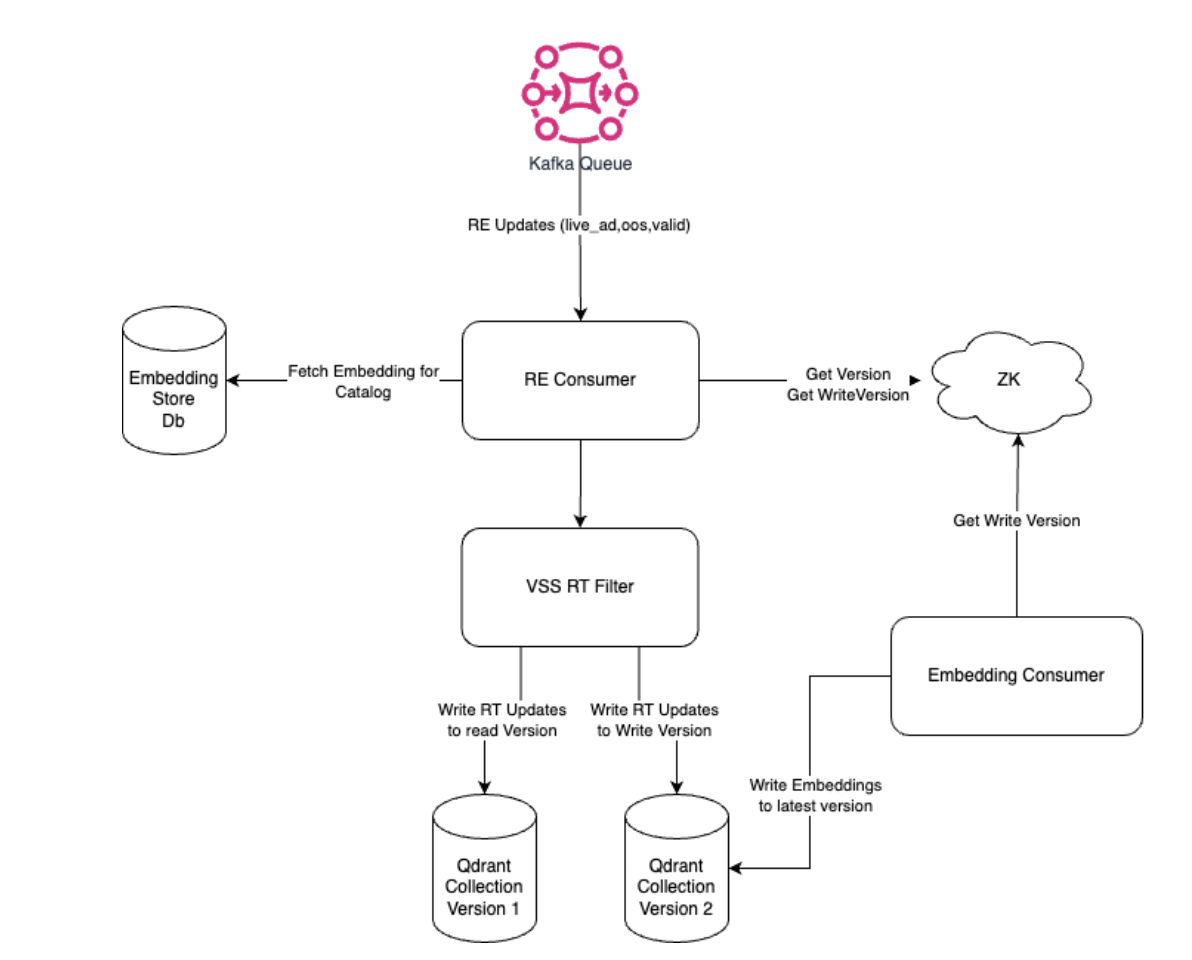
Reset/Delta Ingestion
Embedding ingestion occurs once per model and executes in parallel for each variant. The Kafka event contract supports:
- Multiple variants per event: A single embedding event specifies which variants should index the data
- Separate search and index embeddings: Models can have different embeddings for search space vs index space
- EOF handling: EOF is sent to all partitions to ensure all data is consumed before completion
{
    "entity": "catalog",
    "model_name": "intent_model",
    "candidate_id": "48869419",
    "version": "1",
    "index_space": {
        "variants_version_map": "{'organic':1,'ad':2}",
        "embedding": [0.036, -0.048, ...],
        "variants_index_map": "{'organic':true,'ad':false}",
        "operation": "A",
        "payload": "{'sscat_id':700}"
    },
    "search_space": {
        "embedding": [0.036, -0.048, ...]
    }
}
Real-Time Consumers
A generic Kafka schema is used for all real-time consumers, simplifying new integrations:
{
    "timestamp": 1719308350,
    "entity_label": "catalog",
    "data": [
        {
            "id": "125138466",
            "label": "is_live_ad",
            "value": "true"
        }
    ]
}
Retry Topic
Failed ingestion events are published to a retry topic for reprocessing, ensuring no data loss:
{
    "timestamp": 1719308350,
    "entity_label": "catalog",
    "model_name": "intent_model",
    "variant": "organic",
    "data": [
        {
            "id": "125138466",
            "label": "is_live_ad",
            "value": "true"
        }
    ]
}
Key Design Decisions
Pluggable Vector Database Support
Skye introduces a generic vector_db_type configuration and converts vendor-specific configs to a generic vector_config, enabling support for multiple vector database backends beyond Qdrant.
Variant-Based Model Sharing
By eliminating the tenant-based construct and introducing variants, Skye allows:
- Models to be shared across tenants without duplication
- Each variant to have its own filter criteria, vector DB config, and job frequency
- Independent read/write version tracking per variant
ScyllaDB for Real-Time Aggregation
Replaced Delta Lake with self-hosted ScyllaDB for cost efficiency. The aggregator is entity-generic (not model/version-specific) since all real-time data is consistent across models.
Event-Driven State Management
Model state transitions are handled via Kafka events with a SQL database backing store. This eliminates:
- Single points of failure in admin/ingestion flows
- Models getting stuck during pod restarts
- Manual intervention for consumer pause/resume
Resiliency
| Mechanism | Description |
|---|---|
| Retry Topics | Failed ingestion messages are captured in a failure topic for reprocessing |
| Circuit Breakers | Applied to similarity search API calls to throttle RPS during failures |
| Snapshot Backups | Periodic collection snapshots enable quick restore during downtime |
| Automated Cluster Setup | Scripted provisioning eliminates configuration inconsistencies |
| Databricks Job Retries | Lambda functions with retry mechanisms for failed ingestion jobs |
Scalability
- Vector DB Scaling: Generic scripts for adding nodes to existing clusters, enabling horizontal scaling based on load and RPS
- Service Scaling: Hosted on EKS with CPU-based autoscaling
- Experiment Isolation: Experiments run on separate EKS and vector DB clusters, reducing production cluster complexity
- Indexed-Only Search: The
search_indexed_onlyflag ensures queries only search indexed space, avoiding latency from brute-force searches on partially built indexes
Observability
Metrics (per model + variant)
| Metric | Description |
|---|---|
avg_similar_candidates | Average number of similarity candidates returned |
avg_recall | Score of the first similar catalog returned |
| Service Latency | P99.9 / P99 / P95 / P50 |
| Service 5xx Count | Error rate monitoring |
| Vector DB Latency | P99.9 / P99 / P95 / P50 |
| Vector DB QPS | Throughput monitoring |
| ScyllaDB Latency | P99.9 / P99 / P95 / P90 |
| Redis Latency | P99.9 / P99 / P95 / P90 |
| Redis Hit % | Cache effectiveness |
Alerts
| Alert | Threshold |
|---|---|
| Indexed Vector Count | < 95% |
| Events to Failure Topic | Rate > 0 |
| Service 5xx | < 10 |
| Service Latency | Model-dependent SLA |
Technology Stack
| Component | Technology |
|---|---|
| Language | Go |
| Vector Database | Qdrant (pluggable) |
| Embedding Storage | ScyllaDB |
| Real-Time Aggregation | ScyllaDB |
| Caching | Redis + In-Memory |
| Message Queue | Kafka |
| Configuration | ZooKeeper / etcd |
| Container Orchestration | Kubernetes (EKS) |
| Job Orchestration | Databricks |